Jobs for Women in Riyadh 2026: Where to Look, Pay and Rules for Expats
Female jobs in Riyadh are some of the most searched jobs on GetSaudiJobs. Here is where women are being hired in 2026, what the jobs pay, which roles are reserved for Saudi women, and how non-Saudi women can work legally.
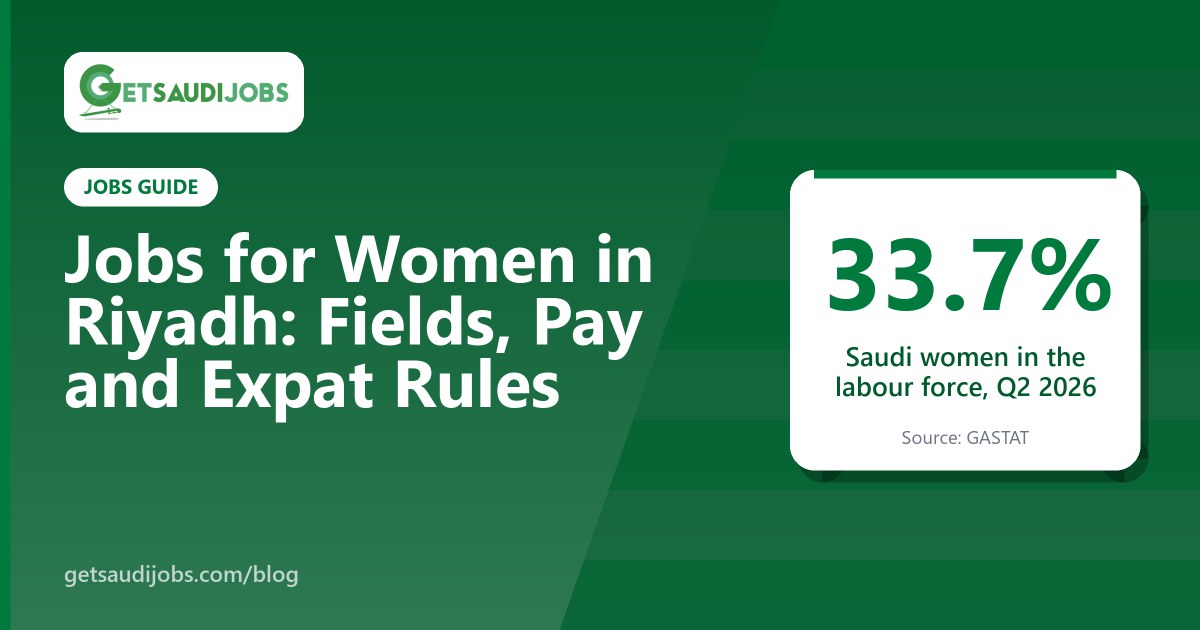
Table of contents
Last reviewed: 29 October 2026. Work permit rules for dependants are changing, so confirm your own case with your employer's HR team, Qiwa or the Ministry of Human Resources and Social Development (MHRSD).
Short answer: the most common jobs for women in Riyadh are in healthcare, teaching, beauty and salons, retail, customer service, HR, marketing, design and IT. Many admin, HR and front-desk roles are now reserved for Saudi women. Non-Saudi women can work when an employer sponsors their work visa, or, if they live in Saudi Arabia as a dependant, when they get a work permit or transfer their Iqama to the employer.
"Jobs for female in Riyadh", "female jobs in Jeddah" and "non Saudi female jobs in Riyadh" are among the top searches that bring people to GetSaudiJobs. Women's jobs are concentrated in Riyadh, then Jeddah. This guide explains where to look and what to check before you apply.
Key takeaways
- About one in three Saudi women is in the labour force: participation was 33.7% in Q2 2026 (GASTAT), up from under 20% in 2017.
- Healthcare, education and beauty hire the most women, and they're open to expats.
- Since April 2026, 69 admin support roles, including secretaries and data entry operators, are reserved for Saudi nationals.
- Non-Saudi women need a work visa sponsored by an employer, or a work permit or Iqama transfer if they're dependants.
- The Labour Law bans wage discrimination between men and women, and gives 12 weeks of paid maternity leave.
Where women are being hired in Riyadh
Women's employment in Saudi Arabia has grown fast since 2017, when Vision 2030 reforms opened more sectors, allowed women to drive and removed many workplace restrictions. Mixed workplaces are now normal in offices, hospitals, retail and hospitality. Growth has slowed in 2026: GASTAT's figures show Saudi women's participation slipping from a peak of 36.3% in early 2025 to 33.7% in Q2 2026. Demand is still strong in these fields:
- Healthcare: nurses, doctors, pharmacists, dental assistants, physiotherapists, lab technologists, medical coders and patient services staff. This is the largest field open to expat women.
- Education: kindergarten and primary teachers, English teachers, teaching assistants and university lecturers. International schools recruit heavily from abroad.
- Beauty, salons and fitness: beauticians, hairdressers, nail technicians, spa therapists and gym trainers for women-only venues.
- Retail and fashion: sales staff in women's shops, abaya and fashion designers, ladies' tailors and visual merchandisers.
- Office roles: HR, recruitment, marketing, social media, graphic design, accounting, customer service and IT.
Riyadh has the most openings by far, from hospitals and schools in Olaya, Al Malqa and the Diplomatic Quarter to the head offices along King Fahd Road and in the King Abdullah Financial District. Jeddah is second, with strong demand in healthcare, retail and hospitality.
Which jobs are for Saudi women only?
Saudization rules reserve many roles for Saudi nationals, and several of them are jobs that women often search for:
- Admin and secretarial roles: under a decision that took effect in April 2026, 69 administrative support professions, including secretary, executive secretary and data entry operator, are reserved for Saudis in the private sector.
- HR management and many front-desk roles are localised, as are customer-facing roles in banks and insurers.
- Sales in women's shops, such as lingerie, cosmetics and abaya stores, has long been reserved for Saudi women.
So if you're not Saudi, look for adverts that say "all nationalities" or "open to expats", or that ask for a licence, such as SCFHS for healthcare or a teaching licence. These roles are much more likely to be open to you. An advert that says "Saudi female" or "Saudization" is not open to non-Saudis, however strong your CV.
Can non-Saudi women work in Saudi Arabia?
Yes. There are two common routes:
- Your own work visa. An employer hires you, sponsors your work visa and issues your Iqama, just as it would for a man. This is the normal route for nurses, doctors and teachers recruited from abroad.
- You're already in Saudi Arabia as a dependant. If you live on your husband's or father's sponsorship, you can't simply start working. Traditionally the employer had to transfer your Iqama to its own sponsorship through Qiwa. Recent reforms reported in 2026 also let qualified dependants apply for a separate work permit through MHRSD without leaving their family's sponsorship. Ask the employer which route it uses before you accept an offer.
Don't work informally on a dependant Iqama. It can lead to fines and problems with your residence, and you won't have Labour Law protection if the employer doesn't pay.
What do women's jobs pay?
| Role | Typical monthly salary (SAR) |
|---|---|
| Beautician, hairdresser, nail technician | 2,500–6,000 plus commission |
| Retail sales associate (expat roles) | 2,500–5,000 plus commission |
| Customer service, receptionist (where open to expats) | 3,000–7,000 |
| Kindergarten or private school teacher | 4,000–9,000 |
| International school teacher | 8,000–20,000, often with housing |
| Staff nurse | 6,000–12,000, often with housing |
| Marketing, HR or graphic design specialist | 5,000–15,000 |
Typical ranges from 2026 Saudi job adverts and recruiter data, not official rates. Women-only jobs advertised on GetSaudiJobs mostly offer SAR 4,000 to SAR 9,000 a month.
The Saudi Labour Law bans wage discrimination between men and women doing work of equal value, so ask for the same package a man would get for the same role. Also check whether the offer includes a transport allowance. Many women rely on taxis or ride-hailing apps, and that cost adds up quickly in Riyadh.
Your rights at work
- Maternity leave: 12 weeks fully paid, under the Labour Law amendments that took effect in February 2025.
- Equal pay: wage discrimination based on gender is prohibited.
- Safe workplace: harassment is a crime under the Anti-Harassment Law, and employers must have a way to report it.
- A written contract on Qiwa with your salary, allowances, hours and leave.
How to get hired faster
- Write a clear, two-page CV with your licence or certificates at the top. Our CV guide for Saudi jobs shows the format.
- Say your Iqama status in the first lines: "transferable Iqama", "dependant visa, eligible for work permit" or "available to relocate".
- Add Arabic if you have it. Even basic Arabic helps in healthcare, retail and customer service.
- Get your certificates attested early. Healthcare and teaching jobs won't start without it.
Never pay a recruiter for a job or visa. In Saudi Arabia the employer pays recruitment and work permit fees. Our Saudi work visa guide explains the process, and our average salary guide helps you judge an offer.
Find jobs for women now
Create a free account and browse jobs in Riyadh, jobs in Jeddah, healthcare jobs, teaching jobs and beauty and fitness jobs. Use the Gender filter on any listing page to see jobs for women.
Sources
- GASTAT Labour Market Statistics, Q2 2026 (Saudi female participation 33.7%), via DataSaudi
- MHRSD decision localising 69 administrative support professions (April 2026), as summarised by EY and law firms
- Saudi Labour Law, as amended (equal pay; maternity leave of 12 weeks from February 2025)
- Anti-Harassment Law (Royal Decree M/96 of 1439H)
- Reports on dependant work permits (Middle East Briefing, Q1 2026); GetSaudiJobs job adverts and recruiter data (salaries)