Driver Jobs in Saudi Arabia 2026: Licence, Salary and How to Get Hired
Driver jobs are among the most searched jobs on GetSaudiJobs, especially in Riyadh. Here is which Saudi licence you need, whether you can convert your home licence, what drivers really earn in 2026 and how to get hired without paying an agent.
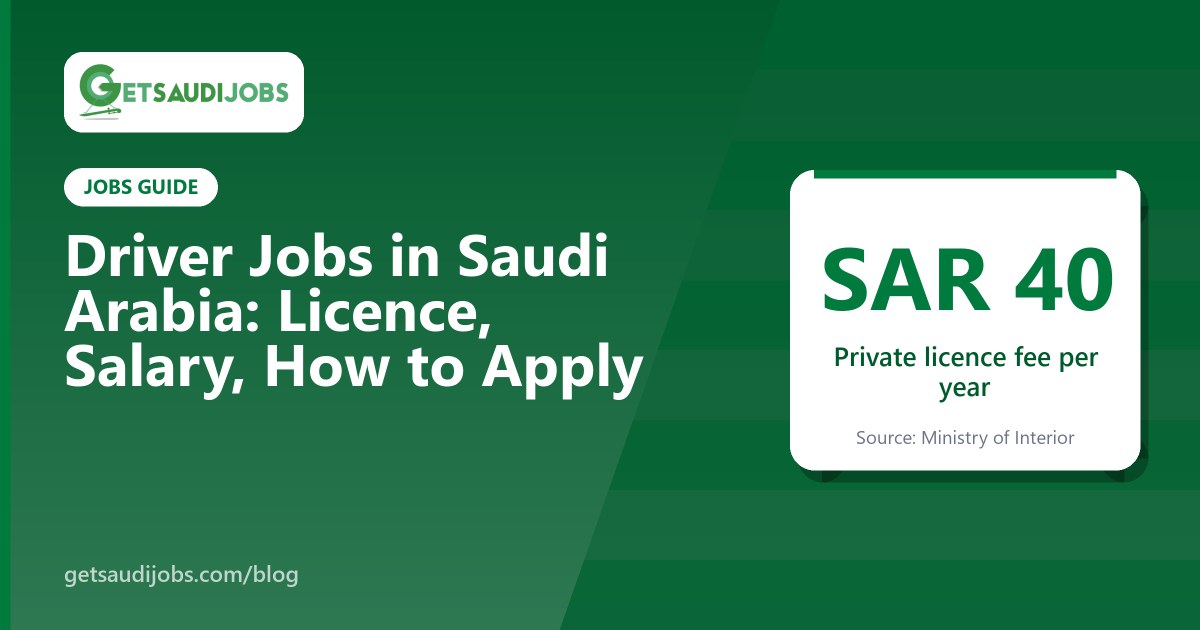
Table of contents
Last reviewed: 29 October 2026. Licence rules and fees change, so check them on Absher or with the General Department of Traffic (Muroor) before you pay for anything.
Short answer: to get driver jobs in Saudi Arabia you need a Saudi driving licence for the right vehicle class, a clean record and a work visa sponsored by your employer. Most light-vehicle and company driver jobs pay about SAR 1,800 to SAR 3,500 a month, often with accommodation. Heavy truck, bus and VIP drivers can earn SAR 3,500 to SAR 6,000.
Searches like "driver jobs in Saudi Arabia", "driver job in Riyadh" and "bus driver jobs in Saudi Arabia" bring more visitors to GetSaudiJobs than almost any other job. Most driver vacancies on the site are in Riyadh, followed by Dammam, Jeddah and Al Khobar. Here's what employers want and how to stand out.
Key takeaways
- You need a Saudi licence to drive for work. A home licence is only valid for a short visit.
- Licences from the GCC, the UK, the US, Canada, Australia, much of Europe, Japan and South Korea can usually be exchanged. Holders from India, Pakistan, Bangladesh, Nepal and the Philippines normally go through a Saudi driving school and tests.
- The government fee for a private licence is SAR 40 per year of validity.
- Typical pay: SAR 1,800–3,500 for light and company drivers, up to about SAR 6,000 for heavy, bus and VIP roles.
- Expats can't do delivery-app work as freelancers. They must be employed by a licensed delivery company.
Which driving licence do you need?
Saudi Arabia issues licences by type, and a good advert tells you which one it wants:
- Private licence: cars and small vehicles. It covers most house driver, company car and light van jobs. The minimum age is 18.
- Public licence: needed to carry passengers or goods commercially, for example buses, taxis, trucks and many company transport jobs. Most guides, and the Riyadh traffic page of the Ministry of Interior, give the minimum age as 21.
- Heavy vehicle and heavy equipment licences: needed for trailers, tankers, cranes, loaders and similar equipment, usually tied to a specific job.
- Motorcycle licence: needed for motorbike delivery jobs.
Everything is booked through Absher, and you'll need a valid Iqama, an eye test and a medical check. If you already live in Saudi Arabia, convert or obtain your licence within the first few months after your Iqama is issued, because employers will ask for it at interview.
Can you convert your home licence?
It depends on where your licence was issued. About 45 to 50 countries are on the exchange list, including the GCC states, the UK, the US, Canada, Australia, New Zealand, Japan, South Korea, Singapore and many European countries. If yours is one of them, you usually need a certified Arabic translation, a medical check and a short visit to a traffic office.
Licences from India, Pakistan, Bangladesh, Nepal, Sri Lanka and the Philippines are generally not on the list. Holders from these countries go through a Saudi driving school. The school assesses you first: experienced drivers are often given a short course, while beginners need the full set of theory and practical lessons. Then you take the computer theory test and a road test. The list is updated from time to time, so check your country's status on Absher before you pay a school.
Many employers, especially bus and logistics companies, pay for the school as part of the job offer. If an employer promises this, make sure it is written in your contract.
What do drivers earn in Saudi Arabia?
| Role | Typical monthly salary (SAR) | Common extras |
|---|---|---|
| House / family driver | 1,500–2,500 | Accommodation, food, annual ticket |
| Light vehicle / company driver | 1,800–3,500 | Accommodation or allowance, overtime |
| Delivery driver (employed by a delivery company) | 2,500–5,000 | Per-order incentives, fuel, vehicle |
| Bus driver (schools, staff transport) | 2,500–4,500 | Accommodation, overtime |
| Heavy truck, trailer or tanker driver | 3,000–6,000 | Trip allowance, accommodation |
| VIP or executive chauffeur | 3,500–6,000 | Uniform, mobile, accommodation |
Typical ranges from 2026 Saudi job adverts and recruiter data, not official rates.
Saudi Arabia has no general minimum wage for expat workers in the private sector, so your pay depends entirely on your contract. That makes it important to compare the whole package. A SAR 2,000 job with free accommodation, food and transport can leave you with more savings than a SAR 2,800 job where you pay rent. There's no income tax on salaries.
Your contract should also be recorded on Qiwa, and your salary should be paid into a bank account through the Wage Protection System. House drivers are domestic workers, so they are recruited through the Musaned platform and covered by the domestic workers regulations rather than the main Labour Law. Your last basic wage decides your end-of-service award; see our end of service benefit guide.
Delivery driver jobs: the rules changed
Delivery work through food and parcel apps is popular, but the rules for expats are strict. Under Transport General Authority rules phased in from 2024, non-Saudis can't work as self-employed delivery drivers. They have to be employed by one of the licensed delivery companies, which must also verify their drivers' identity through a system linked to the authority. Self-employed app delivery is open to Saudi nationals only.
So if an advert asks you to "join as a freelance rider" on your own Iqama, be careful: it may put you in breach of the rules. Look for jobs where a licensed company employs you, provides the vehicle or a fuel allowance, and pays a fixed salary plus incentives.
How to get a driver job quickly
- Get your Saudi licence first if you're in the Kingdom. Adverts often say "Saudi licence must", and licensed drivers are shortlisted first.
- Show you know the roads. Name the areas you know well, for example Riyadh's Olaya, Al Malaz and the industrial areas, Dammam's second industrial city or the Jeddah port area.
- Keep your CV to one page. List your licence type and expiry date, years of driving in the Gulf, the vehicles you've driven and a clean record. Our CV guide for Saudi jobs shows the format employers expect.
- Apply early and keep your phone on. Driver vacancies often fill within days, and recruiters call shortlisted drivers straight away.
- Expect a road test. Most transport and logistics companies test you before they hire.
If you're already in Saudi Arabia, you can move to a new employer through Qiwa once your contract allows it. If you're applying from abroad, your employer sponsors your work visa; our Saudi work visa guide explains each step.
How to avoid driver job scams
- Don't pay for the visa or the job. Under Article 40 of the Saudi Labour Law, the employer pays the recruitment, work permit and Iqama fees.
- Check the company. A real employer has a commercial registration and will give you a written offer before you travel.
- Be wary of WhatsApp-only offers promising high pay with no licence or experience.
- Never drive for work without a valid Saudi licence. Traffic fines are heavy, and the employer can't legally put you on the road.
Find driver jobs now
Create a free GetSaudiJobs account, upload your CV and browse driver jobs in Saudi Arabia, driver jobs in Riyadh or logistics jobs. Forklift and warehouse staff can also look at skilled labour jobs.
Hiring drivers? Employers can post driver jobs free on GetSaudiJobs, with no limit on the number of jobs.
Sources
- Ministry of Interior, General Department of Traffic: licence types, ages and Absher services
- Saudi driving licence fee guides, 2026 (private licence SAR 40 per year), and foreign licence exchange guides
- Transport General Authority delivery regulations (non-Saudi couriers through licensed companies), as reported by Gulf News
- Saudi Labour Law, Article 40 (employer pays recruitment, work permit and Iqama fees)
- GetSaudiJobs job adverts and 2026 recruiter data (salary ranges)