Safety Officer and HSE Jobs in Saudi Arabia 2026: Certificates, Salary and Saudization
Safety officer and HSE jobs are among the largest categories on GetSaudiJobs, driven by giga-projects and the energy sector. Here are the certificates employers want, how Aramco approval works, what HSE staff earn, which roles are Saudized and how to get hired.
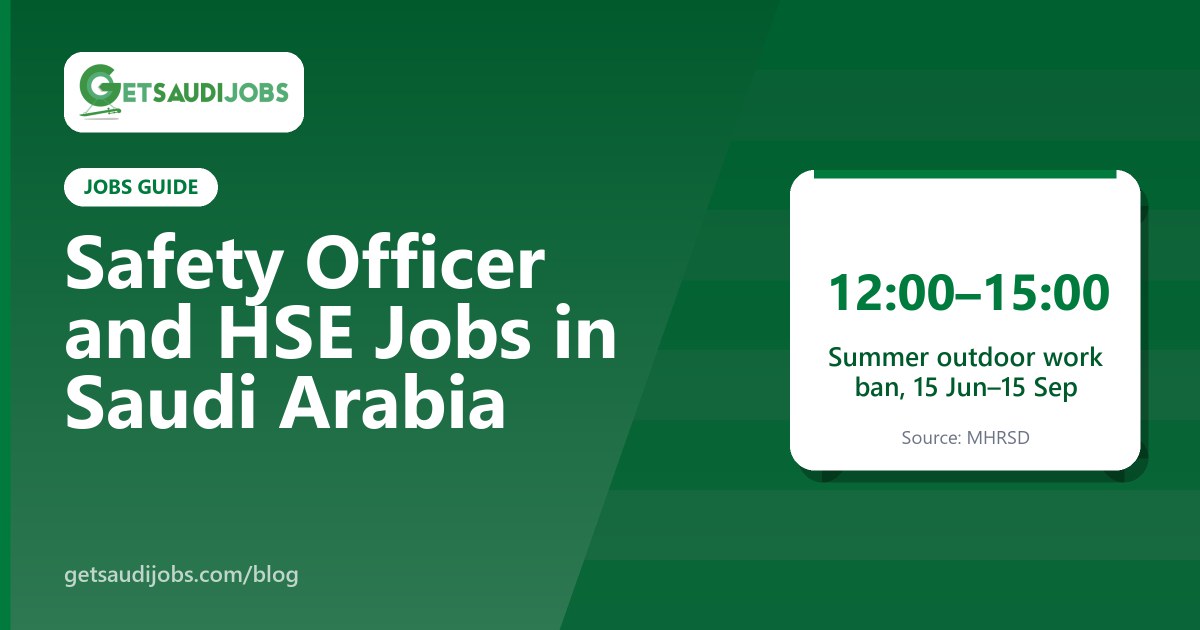
Table of contents
Last reviewed: 29 October 2026. Saudization rates and client requirements change; check the Ministry of Human Resources and Social Development (MHRSD) and the job advert before you apply.
Short answer: safety officer jobs in Saudi Arabia usually need a NEBOSH IGC, OSHA 30-hour or IOSH certificate, two or more years of site experience, ideally in the Gulf, and for oil and gas projects, Saudi Aramco or client approval. Safety officers typically earn SAR 5,000 to SAR 12,000 a month, and HSE managers SAR 15,000 to SAR 30,000+. Many practitioner-level roles are now reserved for Saudis, so expats do best with strong experience and recognised certificates.
"Safety officer jobs in Saudi Arabia" and "HSE jobs in Saudi Arabia" are some of the most viewed searches on GetSaudiJobs, and the safety category has more than 200 open jobs. Most are in Riyadh, followed by Jeddah, Dammam and Jubail. Here's what you need to know.
Key takeaways
- Most adverts ask for NEBOSH IGC, OSHA 30 or IOSH; managers often need NEBOSH Diploma or a degree in occupational safety.
- Oil, gas and utility contractors usually need safety staff approved by Saudi Aramco or the client, often after an interview.
- Occupational safety and health jobs are subject to a Saudization decision with set percentages by company size.
- Typical pay: SAR 5,000–12,000 for safety officers, SAR 15,000–30,000+ for HSE managers.
- Outdoor work under direct sun is banned from 12:00 to 15:00, 15 June to 15 September, and safety officers enforce it.
Where safety officers are needed
- Giga-projects and construction: NEOM, the Red Sea Project, Diriyah, Qiddiya, Riyadh metro and housing projects need large HSE teams on site.
- Oil, gas and petrochemicals: Saudi Aramco, SABIC and their contractors in the Eastern Province, around Dhahran, Dammam, Jubail and Ras Tanura.
- Utilities and industry: power, water, desalination and factories in Riyadh, Jeddah and the industrial cities.
- Facilities management, logistics and events, including malls, airports, warehouses and large venues.
Certificates employers ask for
| Level | Certificates commonly requested |
|---|---|
| Safety officer / HSE officer | NEBOSH IGC, OSHA 30-hour, IOSH Managing Safely, first aid, fire safety |
| Senior HSE officer / HSE engineer | NEBOSH IGC plus a degree in engineering or safety; ISO 45001 lead auditor |
| HSE manager | NEBOSH International Diploma, CSP or a degree in occupational safety, 10+ years' experience |
| Specialist roles | Scaffolding inspector, lifting supervisor, fire and life safety, environmental officer |
Some adverts also ask for an MHRSD safety practitioner qualification, which is linked to the Saudization rules below. Engineering roles, such as HSE engineer, may also need accreditation from the Saudi Council of Engineers.
Saudi Aramco and client approval
On Aramco and other energy projects, the contractor can't simply put any safety officer on site. Safety staff are usually interviewed and approved by the client's loss prevention or HSE department, often with a technical interview on Aramco's safety standards. Many adverts say "Aramco approved" or "SEC approved" (for the Saudi Electricity Company). An existing approval is one of the biggest advantages you can have, because it lets the contractor deploy you straight away. Make it the first line of your CV if you have one.
Saudization of safety jobs
MHRSD issued a decision to localise occupational safety and health professions. It splits HSE staff into two levels: professionals, such as degree holders with recognised safety qualifications, and practitioners, such as diploma holders. Companies above a certain size must reach minimum percentages of Saudi HSE staff, phased in by company size from 2020. That's why you'll see many adverts saying "Health and Safety Officer (Saudi nationals only)".
For expats this means the competition is strongest at junior level. Roles that still recruit widely from abroad are experienced HSE engineers, managers, trainers and specialists, and staff with existing Aramco or client approvals. Read the advert carefully: if it mentions Saudization or "Saudi national", it isn't open to expats.
What do safety officers earn?
| Role | Typical monthly salary (SAR) | Common extras |
|---|---|---|
| Safety officer / HSE officer | 5,000–12,000 | Accommodation, transport, site allowance |
| Senior HSE officer / HSE engineer | 10,000–18,000 | Housing allowance, transport |
| HSE manager | 15,000–30,000+ | Housing, car, family status on bigger projects |
| Fire safety officer | 4,500–10,000 | Accommodation, transport |
Typical ranges from 2026 Saudi job adverts and recruiter data, not official rates.
Remote sites such as NEOM often pay more and add free camp accommodation, food and rotation leave. There's no income tax on salaries, and your basic salary decides your end-of-service award; see our end of service benefit guide.
The summer midday work ban
Every year MHRSD and the National Council for Occupational Safety and Health ban work under direct sunlight from 12:00 to 15:00 between 15 June and 15 September for all private-sector establishments. Safety officers plan shifts, shade, water and rest breaks around it. MHRSD carried out 29,121 inspections during the 2025 season and reported 94% compliance. Employers who break the rule face fines, and workers can report violations on 19911.
Life on a project site
Many safety jobs are on large, remote projects. On sites such as NEOM, the Red Sea Project or desert pipelines, you'll usually live in a company camp with meals included and work long shifts, often 10 hours a day, six days a week. Some contractors offer rotation, for example several weeks on site followed by leave. In return, remote-site packages are usually higher than city jobs, and you spend very little of your salary.
A typical day starts with the morning toolbox talk, then permit-to-work checks, site inspections, monitoring high-risk work such as lifting, excavation and working at height, and recording observations. In summer you'll also manage heat stress: water stations, shaded rest areas, the midday ban and early-morning shifts. Expect to report incidents and near misses, and to train workers who speak many languages, so simple English, pictures and demonstrations matter.
How to get a safety officer job
- Put certificates and approvals first on your CV: NEBOSH, OSHA, IOSH, and any Aramco, SEC or client approvals with dates.
- List the projects you've worked on, with the type (oil and gas, building, infrastructure), size and manpower.
- Show results, such as man-hours without a lost-time injury, audits passed and toolbox talks delivered.
- Keep your CV to two pages. Our CV guide for Saudi jobs shows the format.
- Prepare for a technical interview on permits to work, confined spaces, working at height, lifting plans and heat stress.
Your employer sponsors your visa and pays the fees; never pay an agent. Our Saudi work visa guide explains the steps.
Find safety jobs now
Create a free account and browse safety officer and HSE jobs in Saudi Arabia, HSE jobs in Riyadh, construction jobs and oil and gas jobs.
Sources
- MHRSD, Guideline for the Occupational Safety and Health Profession Saudization Decision
- MHRSD and the National Council for Occupational Safety and Health, midday work ban 15 June to 15 September (2025 inspection figures)
- Saudi Gazette, "Occupation health and safety jobs Saudized" (professionals and practitioners)
- GetSaudiJobs job adverts and 2026 recruiter data (certificates and salary ranges)