Nurse Jobs in Saudi Arabia 2026: SCFHS Licence, Salary and How to Apply
Nursing is one of the largest job categories for expats in Saudi Arabia, with more than 240,000 nurses working in the Kingdom. Here is the SCFHS licence process, what nurses earn in 2026, who hires them and how to apply safely.
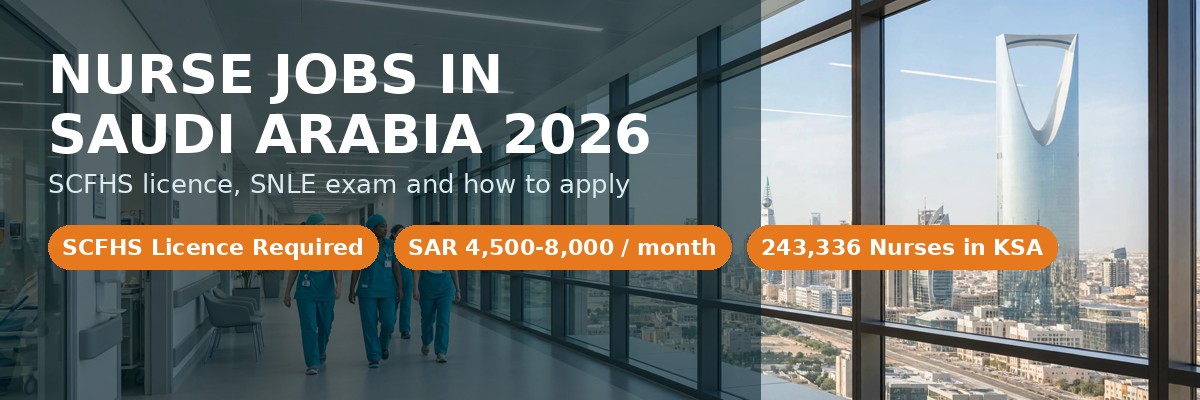
Table of contents
- What does a nurse do in Saudi Arabia?
- Who hires nurses in Saudi Arabia?
- Do I need an SCFHS licence?
- 1. Professional classification
- 2. DataFlow verification
- 3. The SNLE exam
- 4. Professional registration
- What do nurses earn in Saudi Arabia?
- How many nurses does Saudi Arabia need?
- How do I get a nurse job in Saudi Arabia?
- How to avoid nurse job scams
- Find nurse jobs now
- Sources
Last reviewed: 27 November 2026. Licence fees and exam rules change, so check them on Mumaris+ before you pay for anything.
Short answer: to get nurse jobs in Saudi Arabia 2026 you need a recognised nursing qualification, at least one year of experience, and a licence from the Saudi Commission for Health Specialties (SCFHS). Most expat nurses are hired as staff nurses on a tax-free package of about SAR 4,500 to SAR 8,000 a month, usually with housing or a housing allowance, transport and annual flights. Senior and specialist nurses earn more — up to about SAR 14,000 a month and above. Your employer sponsors your work visa and Iqama.
"Nurse jobs in Saudi Arabia", "staff nurse jobs in Riyadh" and "MOH nurse salary" are among the most searched phrases that bring people to GetSaudiJobs, especially from the Philippines, India and Pakistan. Nursing is also one of the few large professions where expats are still hired in big numbers: in 2024 there were 243,336 nurses working in Saudi Arabia, and 56.4% of them were expats. This guide explains the licence, the pay and how to apply — and what to watch out for along the way.
Key takeaways
- Every nurse in Saudi Arabia must be classified and registered by SCFHS through Mumaris+, its online portal.
- Your degree or diploma decides your grade: a BSc in nursing usually means Nurse Specialist; a diploma usually means Nurse Technician, with lower pay.
- Most foreign nurses need DataFlow verification of their certificates and the SNLE exam — 200 multiple-choice questions, pass mark 500 out of 800.
- Typical pay in 2026: SAR 4,500–8,000 a month for a staff nurse, SAR 6,000–11,000 for a specialty nurse, SAR 8,000–14,000 for a charge nurse. Packages are tax-free and usually include housing.
- There were 243,336 nurses in Saudi Arabia in 2024, up from 196,795 in 2021 — demand is still growing, even as more Saudi nurses qualify.
What does a nurse do in Saudi Arabia?
A nurse in a Saudi hospital does the same clinical work as a nurse anywhere else — ward care, medicines, observations, wound care, patient records and handovers — but the setting has a few features that surprise newcomers:
- Shift patterns are long and structured. Most hospital nurses work 8- or 12-hour shifts, including nights and weekends, on a rota. Overtime is common and is usually paid separately, so ask how it is calculated before you accept.
- Most patients are Saudi, and many speak little English. You do not need Arabic to be hired, but even basic Arabic helps enormously on a ward, and some hospitals provide Arabic lessons.
- Female and male nurses work in different areas. Wards are often segregated by the patient's sex, and male nurses are usually placed in male wards, emergency and intensive care, while female nurses cover female and paediatric wards. This is normal in Saudi hospitals and is planned around at recruitment.
- Documentation is electronic. Large hospitals use electronic health records, so you will be expected to chart on a computer system from your first week.
- Ramadan changes the rota. Working hours are shorter during Ramadan, and the hospital adjusts shifts around fasting and prayer times.
The most in-demand specialties are intensive care (ICU), emergency, operating theatre, neonatal intensive care (NICU), dialysis, oncology and cardiac care. Nurses with experience in those areas are shortlisted first and paid more than general ward nurses. If you have a specialty certificate, put it at the top of your CV.
Who hires nurses in Saudi Arabia?
Three kinds of employer hire most expat nurses:
| Employer | What it is | Typical staff nurse pay (SAR/month) |
|---|---|---|
| Ministry of Health (MOH) | Government hospitals in all 13 regions — the biggest single employer | 4,500–8,000 |
| National Guard Health Affairs (NGHA) | Military hospitals, including King Abdulaziz Medical City in Riyadh and Jeddah | 8,000–11,000 (total package) |
| King Faisal Specialist Hospital & Research Centre (KFSH&RC) | The flagship tertiary hospital in Riyadh — BSN and tertiary experience usually required | 7,000–13,000, experienced nurses up to 16,000 |
| Dr. Sulaiman Al Habib Medical Group | Large private hospital group, hiring across the Kingdom | 6,000–9,000 basic, 8,000–13,000 total package |
| Saudi German Hospital | Private hospital group with branches in Jeddah, Riyadh, Dammam and Madinah | 7,000–10,000 total package |
| Other private hospitals | Smaller private hospitals and clinics, often through recruitment agencies | 5,000–9,500 total package |
Pay figures in this table are typical monthly packages from 2026 recruiter and placement guides, not official rates — no Saudi employer publishes an expat nursing pay scale, so always go by your own offer letter. MOH is the volume employer and hires through large recruitment campaigns, often with hospital accommodation and transport provided. NGHA and KFSH&RC pay more but ask for more experience and a BSc. Private groups sit in between, and their packages vary more from hospital to hospital.
Most nursing jobs are in Riyadh, Jeddah and the Eastern Province (Dammam, Al Khobar, Dhahran), where the biggest hospitals are. Our jobs in Riyadh guide and jobs in Jeddah guide cover those cities in detail. Nurses are also hired in Makkah and Madinah, where hospitals expand for the Hajj and Umrah seasons, and in smaller cities through MOH campaigns.
Do I need an SCFHS licence?
Yes. Every nurse who practises in Saudi Arabia — in a government or a private hospital — must be classified and registered by the Saudi Commission for Health Specialties (SCFHS). You cannot work as a nurse without it, and an employer cannot put you on a ward until your registration is complete. The whole process runs on Mumaris+, the SCFHS practitioner portal and app.
There are two steps, and the order matters: first classification, then registration.
1. Professional classification
Classification is SCFHS deciding your professional rank after it studies your qualifications and experience. You apply on Mumaris+ and you can apply from outside Saudi Arabia — you do not need a work permit for this first stage.
| Your qualification | Usual SCFHS grade | What it means |
|---|---|---|
| Bachelor's degree in nursing (BSc) | Nurse Specialist | The standard grade for registered nurses; the higher pay band |
| Nursing diploma (for example GNM) | Nurse Technician | A lower grade with a different scope of practice and lower pay |
| Master's degree or higher, with experience | Senior Specialist or Consultant | Senior grades; SCFHS decides on your full file |
This table is the usual outcome, not a promise: SCFHS decides on your individual file, and if your qualification is not on its recognised list you first apply for a New Qualification Study. The grade matters more than most nurses expect — a diploma nurse classified as a Nurse Technician sits in a different pay band from a BSc nurse, even doing similar ward work, so check your grade before you accept an offer.
2. DataFlow verification
SCFHS verifies every certificate issued outside Saudi Arabia through DataFlow, which contacts your university, nursing council and employers directly. You submit your degree, your home nursing licence and your experience certificates to DataFlow's SCFHS portal, and you get a reference number to enter in Mumaris+. DataFlow's own kit prices a new licence at SAR 500 for nurses, with SAR 300 for each additional document, and gives 15 to 25 working days from payment and a complete set of documents. Other 2026 guides put the total DataFlow cost higher, around SAR 830 to SAR 1,280, so treat the exact fee as something to confirm on the DataFlow portal before you pay.
Start DataFlow early. It is the step that most often delays a file, because it waits on your school or council replying. SCFHS needs the final DataFlow report attached to your classification application, so finish this step before you expect classification to move.
3. The SNLE exam
SCFHS decides each file by one of three routes: a direct decision, a practical evaluation, or a written exam. Degree-level nurses are usually routed to the exam — the Saudi Nursing Licensure Examination (SNLE), booked at a Prometric centre in your own country or in Saudi Arabia.
- Format: about 200 multiple-choice questions in two blocks of 100, about two hours per block, with a break between them. Up to 10% are unscored pilot items.
- Pass mark: 500 on a scaled score from 200 to 800.
- Content: adult health (medical-surgical), maternity, paediatrics, mental health, community health, fundamentals, and leadership and ethics.
- Fee: the SCFHS fee schedule lists an SNLE eligibility fee of SAR 120, and 2026 guides put the total exam cost at about SAR 750 to SAR 1,200. Confirm the amount Mumaris+ shows when you book.
Diploma nurses classified as Nurse Technicians may be assessed differently — check the route SCFHS assigns to your own file rather than assuming you will sit the SNLE.
4. Professional registration
Once you pass and have an employment letter from a Saudi facility, you apply for registration on Mumaris+. You then receive a digital professional licence, usually renewed every two years. The SCFHS fee schedule puts classification and registration together at SAR 760 for a Nurse Technician and SAR 1,340 for a Nurse Specialist, but the amount Mumaris+ shows when you pay is the one that counts, so check it there.
Our guide to GP and doctor jobs in Saudi Arabia covers the same SCFHS system for doctors, including the SMLE exam, if you want to compare the two routes.
What do nurses earn in Saudi Arabia?
There is no official expat nursing pay scale, and no general minimum wage for expatriate workers in Saudi Arabia, so your contract decides your pay. The ranges below are typical monthly packages from 2026 recruiter and placement guides, blended from campaign offers and offers recruiters have seen. They are tax-free — Saudi Arabia has no income tax on salaries — and most include housing or a housing allowance, transport and annual flights on top of the cash figure.
| Role | Typical monthly package (SAR) |
|---|---|
| Nurse Technician (diploma) | 3,000–6,000 |
| Staff nurse / Registered nurse (3–5 years) | 4,500–8,000 |
| Specialty nurse (ICU, ER, OR, NICU, dialysis) | 6,000–11,000 |
| Charge nurse / Head nurse | 8,000–14,000 |
| Nursing supervisor and above | 10,000–15,000 |
| Senior specialist | 14,000+ |
Three things move you up or down inside those bands:
- Experience. SCFHS requires at least one year of experience for nurses who qualified abroad, and most employers ask for two years. A nurse with 6 to 10 years earns roughly 10 to 15% more than a nurse with 3 to 5 years in the same grade.
- Specialty. ICU, NICU, operating theatre, dialysis and cardiac nurses earn a premium over general ward nurses, and a specialty certificate helps at interview.
- Employer. MOH pays the volume band with accommodation provided; NGHA and KFSH&RC pay more; private groups vary. A SAR 6,000 job with free housing can leave you with more than a SAR 8,000 job where you pay rent yourself, so compare the whole package, not just the basic salary.
Packages usually also include medical insurance, annual leave of about 30 days, an annual flight home, and an end-of-service benefit. Our end-of-service benefit guide explains how that is calculated, and our average salary guide puts nursing pay beside the official GASTAT averages — about SAR 5,800 a month for all paid employees in Q2 2026, and SAR 4,090 for non-Saudi employees across all jobs.
How many nurses does Saudi Arabia need?
Demand is still growing. The nursing workforce rose from 196,795 in 2021 to 243,336 in 2024, according to the Ministry of Health Statistical Yearbook — an increase of about 24% in three years. Of those 243,336 nurses, 106,145 were Saudi (43.6%) and 137,191 were expats (56.4%). Older guides still quote "over 180,000 nurses, about 60% expats"; that figure is out of date, and the 2024 yearbook figure is the one to use.
Two forces pull in opposite directions for expat nurses. On one side, the Kingdom keeps building hospitals — new medical cities, private hospital groups expanding, and the Health Sector Transformation Programme under Vision 2030 — and the nurse-to-population ratio is still below the level the World Health Organization recommends, at around 5 nurses per 1,000 people against a recommended 8. On the other side, the government is training more Saudi nurses: the number of Saudi nurses rose from 88,762 in 2021 to 106,145 in 2024. But expat nurses still filled most of the new jobs in that period — about 63% of the net growth — because the total workforce grew faster than Saudi training could keep up.
For a foreign nurse, the practical read is this: licensed, experienced nurses are still being recruited in large numbers, especially in specialties, but the competition is real and the licence is the gate. A nurse without SCFHS classification will not be shortlisted, however strong the CV.
How do I get a nurse job in Saudi Arabia?
- Check you qualify. A recognised nursing qualification, a valid home registration, and at least one year of experience (two is what most employers ask for). If your qualification is not on the SCFHS recognised list, apply for a New Qualification Study first.
- Start DataFlow verification. Submit your degree, licence and experience certificates to DataFlow and get your reference number. Do this before you apply anywhere, because it takes weeks.
- Apply for SCFHS classification on Mumaris+. Create your account, apply for Professional Classification, and pay the fee Mumaris+ shows. SCFHS will route you to a direct decision, a practical evaluation or the SNLE exam.
- Sit the SNLE if SCFHS asks for it. Book a Prometric centre, prepare from the exam blueprint (adult health, maternity, paediatrics, mental health, community health, fundamentals, leadership and ethics), and aim well above the 500 pass mark.
- Apply to hospitals and licensed recruiters. Apply to MOH campaigns, NGHA, KFSH&RC and the private groups directly, and to licensed recruitment agencies in your own country. Our CV guide for Saudi jobs shows the format recruiters expect, and the free CV maker guide builds one without Word or a paid template.
- Check the offer in writing. Basic salary, housing, transport, hours, overtime, leave, flights and the job title that will appear on your work permit. Compare it with the pay table above before you accept.
- Let the employer handle the visa. Your employer sponsors your work visa and Iqama and pays the recruitment, work permit and Iqama fees. Our Saudi work visa guide explains each step.
How to avoid nurse job scams
- Never pay an agent for a job or a visa. Under Article 40 of the Saudi Labour Law, the employer pays the recruitment, work permit and Iqama fees. A request for visa money, "processing fees" or a "security deposit" is a common sign of a scam.
- Check the employer exists. A real hospital has a website, a commercial registration and a careers page. If the only contact is a WhatsApp number and the offer promises SAR 15,000 for a first nursing job with no licence, walk away.
- Do not pay for the licence through an agent. SCFHS fees are paid on Mumaris+ and DataFlow fees on the DataFlow portal. An agent who asks you to send licence money to a personal account is not acting for SCFHS.
- Check the contract is on Qiwa. Your contract should be recorded on Qiwa with your salary, allowances, hours and leave, and your salary should be paid into a bank account through the Wage Protection System.
- Verify the recruiter. In the Philippines, check the agency with the Department of Migrant Workers; in India, check emigration clearance through eMigrate; in Pakistan, register with the Protector of Emigrants before you travel.
Find nurse jobs now
Create a free GetSaudiJobs account and upload your CV, then browse healthcare and nursing jobs in Riyadh, Jeddah and Dammam. Also read our doctor jobs guide if you are applying with a doctor spouse, and our medical coding guide if you are considering a move from bedside nursing into coding — it uses Australian coding standards, not the US system, and pays differently from ward nursing.
Sources
- Saudi Commission for Health Specialties (SCFHS), via Mumaris+ service guides — professional classification, professional registration, fee schedule (Nurse Technician SAR 760, Nurse Specialist SAR 1,340, classification and registration together)
- DataFlow, SCFHS reference kit — SAR 500 for nurses, SAR 300 per additional document, 15 to 25 working days
- OnClick Healthcare, SCFHS licence guide 2026 — Mumaris+ steps, classification routes, service levels
- Nursing Media Network, SCFHS Saudi nursing licence guide 2026 — SNLE format (200 questions, pass mark 500 out of 800), DataFlow and registration steps
- Wathim, Requirements to Work as a Nurse in Saudi Arabia 2026 — at least 1 year of experience for non-Saudis, SNLE eligibility fee SAR 120, fees checked 20 November 2026 against SCFHS sources
- Prometric Medical Consultancy, Nurse Salary in Saudi Arabia 2026 and Saudi MOH Nurse Salary 2026 — staff nurse SAR 4,500–8,000, specialty SAR 6,000–11,000, charge nurse SAR 8,000–14,000, supervisor SAR 10,000–15,000, MOH and KFSH&RC employer bands
- Neelim Healthcare Consulting, Staff Nurse Salary in Saudi Arabia 2026 — typical total package SAR 6,000–11,000, senior and specialist grades to SAR 16,000–22,000
- ScoJob, Nurse Jobs in Saudi Arabia 2026 — salary about SAR 4,500–11,000 for most expat nurses, senior specialist SAR 14,000+
- GulfTalent, Staff Nurse salaries in Saudi Arabia, updated 1 November 2026 — average SAR 6,000, range SAR 4,000–9,000, based on 39 registered staff nurses
- Ministry of Health, Statistical Yearbook 2024, via Frontiers in Public Health (2026) — 243,336 nurses in 2024, 106,145 Saudi (43.6%), 137,191 expats (56.4%), up from 196,795 in 2021
- GASTAT, Labour Market Statistics, Q2 2026 — average monthly wage about SAR 5,800 for all paid employees, SAR 4,090 for non-Saudis
- Saudi Labour Law, Article 40 (employer pays recruitment, work permit and Iqama fees)
- GetSaudiJobs guides: doctor jobs, medical coding jobs, average salary, Saudi work visa, CV for Saudi jobs, end-of-service benefit, jobs in Riyadh, jobs in Jeddah