GP and Doctor Jobs in Saudi Arabia 2026: SCFHS Licence, SMLE and How to Apply
Every doctor working in Saudi Arabia must be classified and registered by the Saudi Commission for Health Specialties. Here is how GP and doctor licensing works through Mumaris Plus and DataFlow, what the SMLE exam involves, what affects pay and how to find a job.
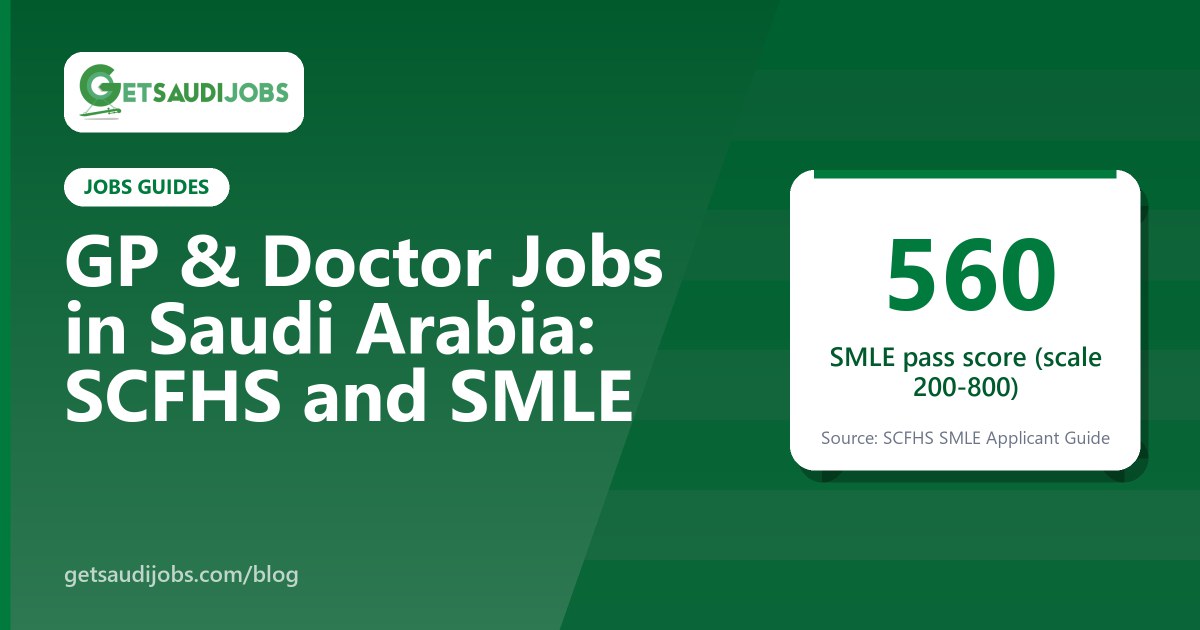
Table of contents
- Who hires doctors and GPs in Saudi Arabia?
- How do I get an SCFHS licence as a doctor?
- What is the SMLE and do GPs need it?
- What level will I be classified at?
- How much do doctors earn in Saudi Arabia?
- Where are GP jobs in Riyadh and Jeddah?
- How do I keep my licence?
- How to apply for doctor jobs in Saudi Arabia
- Sources
Last reviewed: 23 November 2026. Licensing rules and processing times change; confirm them with the Saudi Commission for Health Specialties (SCFHS) before you apply.
Short answer: to get doctor jobs in Saudi Arabia, including GP jobs, you need a recognised medical degree, primary source verification of your documents through DataFlow, a professional classification from the Saudi Commission for Health Specialties (SCFHS) on its Mumaris Plus portal, and then SCFHS registration before you start work. Depending on your case, SCFHS may ask you to pass an exam such as the Saudi Medical Licensure Examination (SMLE). Your employer sponsors the work visa.
"GP jobs in Saudi Arabia" and "GP jobs in Riyadh" bring doctors to GetSaudiJobs every month, many from Pakistan and India. This guide walks through each step in order.
Key takeaways
- All licensing goes through SCFHS: Mumaris Plus account, DataFlow verification, classification, exam or evaluation if required, then registration.
- Non-Saudi practitioners need at least one year of experience for classification (SCFHS requirements).
- The SMLE has 200 multiple-choice questions over four hours, taken at Prometric centres, and the pass score is 560 on a 200 to 800 scale.
- Registration lasts two years, and doctors need 60 CPD hours to renew it.
- The employer pays the visa, work permit and Iqama fees.
Who hires doctors and GPs in Saudi Arabia?
Doctors are hired by government hospitals and health clusters, large private hospital groups, polyclinics and medical complexes, and companies that run their own clinics, such as occupational health services on industrial and construction sites. GP adverts on GetSaudiJobs mostly come from polyclinics, medical centres and specialist recruiters in Riyadh and Jeddah, with fewer in Dammam, Madinah and Hail. Emergency medicine, internal medicine, paediatrics and occupational health appear regularly alongside general practice.
Adverts that ask for "SCFHS licensed" or "Prometric passed" doctors want someone whose classification is done or under way.
How do I get an SCFHS licence as a doctor?
The steps below are the ones SCFHS describes for Mumaris Plus. Processing times are the commission's own service targets, in working days.
| Step | What happens | SCFHS time |
|---|---|---|
| 1. Mumaris Plus account | Create your profile on the SCFHS portal and upload your documents | n/a |
| 2. DataFlow verification | DataFlow checks your degree, licence and experience with the issuing bodies | Varies by country and institution |
| 3. Classification request | SCFHS decides your professional title and level | 7 days for a direct decision |
| 4. Exam or evaluation | An electronic written exam (Prometric or Pearson VUE) or a practical evaluation, if your decision requires one | 30 days (written) or 35 days (practical); results up to 14 days |
| 5. Registration | Once you have a Saudi ID (Iqama), you register before starting work | 5 days |
Source: SCFHS, Mumaris Plus FAQ.
For classification, SCFHS asks non-Saudis for their qualification certificates (all of them, including the MBBS when you apply on a postgraduate degree), an academic record, a valid professional registration certificate from the country where you last practised, an experience letter, and an employment letter issued within the last three months. Experience must be at least one year, except for graduates of Saudi universities.
Tip: DataFlow is usually the slowest step. Ask your university, medical council (PMDC in Pakistan, or the NMC or state council in India) and previous hospitals to answer DataFlow quickly.
What is the SMLE and do GPs need it?
The Saudi Medical Licensure Examination is the SCFHS exam for doctors who want to practise in Saudi Arabia or enter Saudi postgraduate training. According to the SCFHS applicant guide:
- It has 200 multiple-choice questions, of which up to 20 are unscored pilot questions.
- It runs for four hours in two sections of 100 questions (120 minutes each) with a 30-minute break.
- You can sit it at SCFHS-approved Prometric centres in Saudi Arabia and abroad.
- The pass score is 560 on a reporting scale of 200 to 800.
- You can take it up to four times a year until you pass, and results come out two to six weeks after the testing window closes.
SCFHS doesn't publish one rule that sends every foreign GP to the SMLE. Your classification decision on Mumaris Plus tells you which exam or evaluation applies, and some applicants are classified directly. Specialists and consultants are assessed on their postgraduate qualifications and experience, and may face a specialty exam or oral assessment instead. Always prepare for the exam your decision names, not the one a forum post mentions.
What level will I be classified at?
Your level depends on your highest recognised qualification and your experience after it. In broad terms, a doctor with an MBBS and the required experience is classified as a general practitioner (also called a resident), a doctor with a recognised postgraduate qualification as a specialist (registrar or senior registrar), and a specialist with further years of experience as a consultant. Job adverts use these titles, so check that your expected classification matches the role before you apply.
How much do doctors earn in Saudi Arabia?
There is no single published salary scale for expatriate doctors in the private sector, so pay varies widely. The biggest factors are your SCFHS level (GP, specialist or consultant), your specialty, the employer (government hospital, large private group or small polyclinic), the city and your experience. Most offers combine a basic salary with housing or a housing allowance, transport, medical insurance, annual flights and an end-of-service award, and there is no income tax on salaries.
When you compare offers, ask for the full monthly breakdown in writing and check whether the employer pays the SCFHS fees, exam costs and DataFlow fee. Our average salary guide explains how Saudi packages are built and how to judge an offer.
Where are GP jobs in Riyadh and Jeddah?
Riyadh has the largest share of doctor adverts on GetSaudiJobs, followed by Jeddah. Browse healthcare jobs in Riyadh and healthcare jobs in Jeddah, or all healthcare jobs in Saudi Arabia. If you are looking at Jeddah, our guide to jobs in Jeddah covers the main employers and living costs.
How do I keep my licence?
SCFHS registration is valid for two years. You can apply to renew three months before it expires, and doctors need 60 CPD hours in each cycle. Hours earned abroad can be added through Mumaris Plus.
How to apply for doctor jobs in Saudi Arabia
- Start Mumaris Plus and DataFlow early, even before you have an offer.
- Prepare a two-page medical CV with your degree, council registration, SCFHS status, specialties, procedures and the hospitals you worked in. Our CV guide for Saudi jobs shows the format, and the free CV maker builds one in minutes.
- Apply to real employers and licensed recruiters, and get the offer in writing.
- Let the employer sponsor your visa. Under Article 40 of the Labour Law they pay the recruitment, work permit and Iqama fees. Our Saudi work visa guide explains the steps.
Health information staff can also read our medical coding jobs guide.
Sources
- Saudi Commission for Health Specialties (SCFHS): Mumaris Plus FAQ (steps, processing times, registration and CPD hours) and professional classification requirements
- SCFHS, Saudi Medical Licensure Examination (SMLE) Applicant Guide
- Saudi Labour Law, Article 40 (employer pays recruitment, work permit and Iqama fees)
- GetSaudiJobs job adverts, 2024 to 2026