Tailor Jobs in Saudi Arabia 2026: Ladies Tailor Salary, Skills and How to Apply
Tailoring is one of the most viewed job categories on GetSaudiJobs, and "ladies tailor job in Saudi Arabia salary" is a top search. Here is what tailors earn, the skills employers test, the rules for women's tailoring shops, and how to get hired safely.
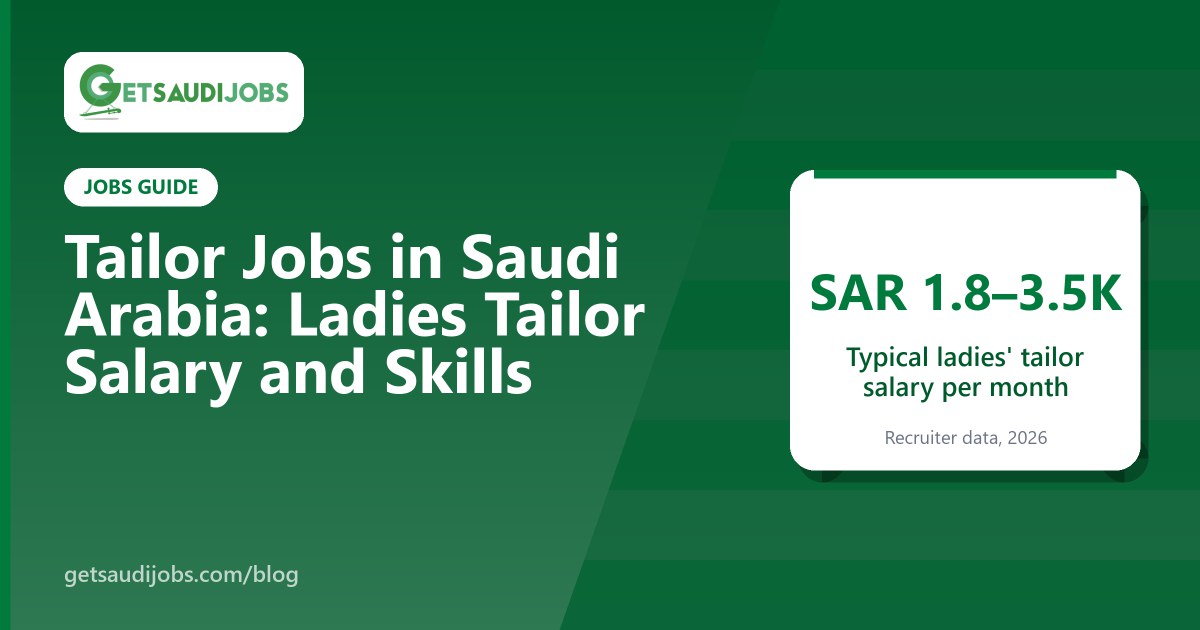
Table of contents
Last reviewed: 29 October 2026. Saudization rules for shops change; check the job advert and the Ministry of Human Resources and Social Development (MHRSD) before you apply.
Short answer: tailor jobs in Saudi Arabia usually pay SAR 1,500 to SAR 4,500 a month, often with accommodation. Experienced ladies' tailors, abaya cutters and master cutters earn more, and some workshops add a commission per piece. Employers want proven experience and almost always give a practical test. Most jobs are in Riyadh, Jeddah and Madinah.
Our tailoring category is one of the most viewed pages on GetSaudiJobs, with thousands of Google views in the last three months. Searches like "ladies tailor jobs in Saudi Arabia", "gents tailor jobs in Saudi Arabia Riyadh" and "ladies tailor job in Saudi Arabia salary" come mostly from experienced tailors in Pakistan, India and Bangladesh. This guide answers their main questions.
Key takeaways
- Typical pay: SAR 1,500–3,000 for tailors, SAR 3,000–4,500+ for master cutters and senior ladies' tailors.
- Main employers: ladies' tailoring shops, abaya and thobe workshops, fashion houses and uniform factories.
- In 2015 the Labour Ministry announced it would stop issuing new visas for men to work in women's tailoring and dressmaking shops, to open the sector to Saudi women.
- Expect a trade test: cutting, stitching and finishing a garment in front of the employer.
- The employer pays your visa and Iqama; never pay an agent.
Types of tailor jobs
- Ladies' tailor: dresses, evening wear, jalabiyas and alterations, usually for a tailoring shop or boutique.
- Abaya tailor or cutter: abayas and modest wear, often in workshops that supply shops across the Kingdom.
- Gents' tailor: thobes, bishts and suits. Thobe tailoring is a large trade in every Saudi city.
- Master cutter: takes measurements, makes patterns and cuts fabric. This is the most senior and best-paid role.
- Machine operator or stitcher: production sewing in uniform and garment factories.
- Embroidery operator: hand or computer embroidery for abayas, thobes and uniforms.
What do tailors earn in Saudi Arabia?
| Role | Typical monthly salary (SAR) | Common extras |
|---|---|---|
| Machine operator / stitcher | 1,200–2,000 | Accommodation, transport |
| Gents' tailor (thobe) | 1,500–3,000 | Accommodation, piece commission |
| Ladies' tailor | 1,800–3,500 | Accommodation, piece commission |
| Abaya tailor / cutter | 1,800–3,500 | Accommodation |
| Master cutter / head tailor | 3,000–4,500+ | Accommodation, bonus |
| Embroidery machine operator | 1,500–2,800 | Accommodation |
Typical ranges from 2026 Saudi job adverts and recruiter data, not official rates.
Pay depends heavily on your skill and the shop's customers. A tailor who can cut and finish high-end evening wear in Riyadh or Jeddah earns far more than one doing simple alterations. Some shops pay a fixed salary plus commission per piece; ask how the commission works and whether it's written into your contract. Busy seasons, especially before Ramadan and Eid and the wedding season, mean long hours. Under the Labour Law, overtime should be paid at your hourly wage plus 50% of your basic wage.
Saudi Arabia has no general minimum wage for expats, so always compare the full package, including free accommodation, and remember there's no income tax.
Rules for women's tailoring shops
In 2015 the Labour Ministry, now MHRSD, announced that it would stop issuing new visas for men to work in women's tailoring and dressmaking shops, as part of a plan to bring Saudi women into the sector. Saudi women have also long had priority in sales jobs in women's shops, such as abaya and lingerie stores.
In practice, the trade still employs many expat tailors, especially in workshops and factories, men's tailoring and abaya production, but rules differ by activity and are enforced in inspections. Check that the visa profession and workplace in your contract match the job you'll really do. Working in a different shop or for a different employer from your sponsor is illegal and can lead to deportation.
For women tailors, this is good news: women's tailoring shops and fashion houses increasingly look for female tailors and designers. Our guide to jobs for women in Riyadh explains how non-Saudi women can work legally.
Skills employers test
- Taking measurements accurately and drafting patterns by hand.
- Cutting without wasting fabric, including expensive crepe, chiffon and embroidered fabrics.
- Machine work on industrial straight-stitch and overlock machines.
- Finishing: hand stitching, hems, buttons, zips and pressing.
- Styles: abaya, jalabiya, kaftan, evening dress or thobe, depending on the shop.
Tailoring is a skilled trade, so check whether your visa profession needs the Skills Verification Program (SVP) test in your home country before the visa is issued. Our guide to labour jobs and visa sponsorship explains how SVP works.
Where the work is, and when it's busiest
Riyadh has the most tailoring shops, abaya workshops and fashion houses, from small shops in old districts like Al Batha to boutiques in Olaya and Al Malqa. Jeddah is the second centre, with many abaya and fashion businesses. Madinah and Makkah have strong demand for thobes, ihram and modest wear, especially around Hajj and Umrah seasons. Uniform factories in the industrial cities of Riyadh, Jeddah and Dammam hire machine operators all year.
The trade is seasonal. The busiest months are the weeks before Ramadan, Eid al-Fitr and Eid al-Adha, when families order new thobes, abayas and dresses, and the wedding season, when evening wear and bridal orders peak. Shops often hire extra tailors before these periods, so it's a good time to apply. During the rush, expect long days, but also more chances to earn commission.
Growing your career as a tailor
The best-paid tailors move from simple stitching to cutting and pattern making, because that's where mistakes cost the most and skill is hardest to find. Learning to work with premium fabrics and embroidery, and with pattern software or computer embroidery machines, also raises your value. Some experienced tailors move into head tailor or workshop supervisor roles, managing a team and dealing with customers. Arabic for measurements, fabrics and customer requests helps a lot.
How to get a tailor job
- Make a photo portfolio of garments you've made, especially abayas, dresses and thobes. Employers often decide from the photos.
- Write a short CV with your years of experience, the garments you specialise in, the machines you use and any Gulf experience. Our CV guide shows the format.
- Be ready for a trade test, in person or by video, where you cut and stitch a garment.
- Check the contract for salary, commission, accommodation and working hours before you travel.
Never pay for a visa or a "free visa" offer. Under Article 40 of the Labour Law, the employer pays the recruitment, work permit and Iqama fees. Our Saudi work visa guide explains each step.
Find tailor jobs now
Create a free GetSaudiJobs account and browse tailoring jobs in Saudi Arabia, fashion designer jobs and skilled trade jobs. New tailoring jobs appear often, so set up a job alert after you register.
Hiring tailors? Shops and workshops can post tailor jobs free on GetSaudiJobs.
Sources
- Saudi Gazette, "No more visas for men at ladies' tailoring shops" (October 2015)
- Saudi Labour Law, Article 40 (employer pays recruitment and Iqama fees) and Article 107 (overtime)
- Takamol Skills Verification Program (via NAVTTC Pakistan)
- GetSaudiJobs job adverts and 2026 recruiter data (salary ranges)